CUET 2027 Eligibility Criteria: Age Limit, Qualification, Minimum Marks & University-Wise Rules
Complete guide covering who can apply, age limit, Class 12 requirements, subject eligibility, NIOS eligibility and university-specific admission conditions.

Planning to appear for CUET UG 2027? Understanding eligibility criteria is the first step toward securing admission in top universities. While the National Testing Agency allows a broad range of students to appear, individual universities may impose additional conditions regarding subjects, minimum marks and course-specific qualifications.
What is the Eligibility for CUET 2027?
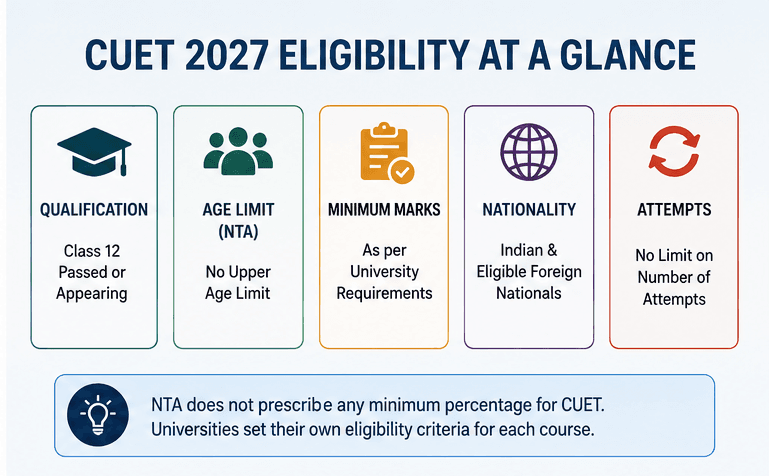
The basic eligibility criteria for CUET UG 2027 require candidates to have passed or be appearing in Class 12 from a recognized board such as CBSE, ICSE, State Boards, NIOS, or any equivalent examination. There is currently no upper age limit for appearing in the CUET examination, making it accessible to both fresh Class 12 students and gap-year candidates. The National Testing Agency (NTA) does not prescribe a minimum percentage requirement for the entrance test itself; however, participating universities may specify minimum marks, subject combinations, and course-specific qualifications for admission. Therefore, students should not only check CUET 2027 eligibility criteria but also carefully review the eligibility requirements of their preferred universities and courses before applying.
CUET 2027 Eligibility Criteria: Quick Overview
Before applying for CUET UG 2027, candidates should understand the key eligibility requirements related to educational qualification, age limit, minimum marks, subject selection, nationality and university-specific admission rules. The table below provides a quick summary of the most important CUET 2027 eligibility criteria.
| Eligibility Criteria | CUET 2027 Requirement |
|---|---|
| Educational Qualification | Passed or appearing in Class 12 or equivalent examination |
| Recognized Boards | CBSE, ICSE, State Boards, NIOS and other recognized boards |
| Age Limit | No upper age limit prescribed by NTA |
| Minimum Marks | No minimum marks required by NTA; universities may specify requirements |
| Subject Requirements | Depends on the course and university selected |
| Gap-Year Students | Eligible to apply |
| NIOS Students | Eligible to apply subject to university rules |
| Number of Attempts | No restriction on attempts |
| Nationality | Indian citizens and eligible foreign nationals |
| Final Admission Eligibility | Determined by the participating university and course requirements |
Who Can Apply for CUET 2027?
Students who have passed or are appearing in Class 12 from a recognized board are eligible to apply for CUET UG 2027. The examination is open to candidates from CBSE, ICSE, State Boards, NIOS and other recognized educational institutions. Fresh Class 12 students, gap-year candidates, previous-year pass-outs and eligible international applicants can all appear for CUET, provided they satisfy the eligibility requirements of the universities and courses they wish to apply for. While the National Testing Agency (NTA) conducts the examination, final admission eligibility is determined by the participating universities.
- Students appearing for Class 12 examinations in 2027
- Students who have already passed Class 12 in previous years
- CBSE, ICSE and State Board students
- NIOS and other recognized open-school students
- Gap-year candidates seeking undergraduate admissions
- Students applying for Delhi University, BHU, JMI and other CUET-participating universities
- Indian citizens meeting university-specific requirements
- Eligible foreign and international candidates
Candidates should remember that being eligible to appear for CUET 2027 does not automatically guarantee eligibility for every course. Many universities prescribe specific subject combinations, minimum marks requirements and additional admission conditions for particular programs.
CUET 2027 Age Limit: Is There Any Maximum Age?
No, there is currently no upper age limit for appearing in CUET UG 2027. According to the National Testing Agency (NTA), candidates of any age can apply for the examination provided they meet the required educational qualifications. This means Class 12 appearing students, previous-year pass-outs, gap-year candidates and even older applicants seeking undergraduate admissions are eligible to take the test. However, while NTA does not impose an age restriction, participating universities may prescribe additional eligibility conditions for certain courses. Therefore, candidates should always verify university-specific admission requirements before applying.
Can Gap-Year Students and Older Candidates Apply for CUET 2027?
Yes. Students who completed Class 12 in previous years can apply for CUET 2027 without any restriction on the year of passing. Whether you passed Class 12 recently or several years ago, you can appear for the examination if you satisfy the university's admission criteria. This flexibility makes CUET an attractive option for drop-year students, career changers and candidates seeking admission after a break in their education.
| Age-Related Eligibility Factor | CUET 2027 Rule |
|---|---|
| Upper Age Limit | No upper age limit prescribed by NTA |
| Minimum Age | As per Class 12 eligibility requirements |
| Gap-Year Students | Eligible |
| Previous-Year Pass-Outs | Eligible |
| Working Professionals | Eligible if educational requirements are met |
| Final Admission Eligibility | Subject to university-specific rules |
Can Gap-Year Students Apply for CUET 2027?
Yes, gap-year students are fully eligible to apply for CUET UG 2027. The National Testing Agency (NTA) does not impose any restriction on the year in which a candidate passed Class 12. Students who completed their higher secondary education in 2026, 2025 or even earlier years can appear for CUET provided they satisfy the eligibility requirements of their chosen universities and courses. This flexibility allows students who took a drop year for competitive exam preparation, personal reasons, skill development or career planning to continue pursuing admission to top universities through CUET.
Candidates should note that while CUET permits previous-year pass-outs to appear for the examination, admission eligibility is ultimately determined by the participating universities. Some courses may require specific subject combinations, minimum marks in Class 12 or additional eligibility conditions. Therefore, students should carefully review the admission guidelines of universities such as Delhi University (DU), Banaras Hindu University (BHU), Jamia Millia Islamia (JMI) and other participating institutions before submitting their applications.
| Gap-Year Eligibility Factor | CUET 2027 Rule |
|---|---|
| Students Passing Class 12 in 2027 | Eligible |
| Students Passing Class 12 in 2026 | Eligible |
| Students Passing Class 12 Before 2026 | Eligible |
| Drop-Year Candidates | Eligible |
| Maximum Gap-Year Limit | No restriction by NTA |
| Final Admission Eligibility | Depends on university-specific requirements |
Educational Qualification Required for CUET 2027
To be eligible for CUET UG 2027, candidates must have passed or be appearing in Class 12 or an equivalent examination from a recognized board. Students from CBSE, ICSE, State Boards, NIOS and other recognized educational boards are generally eligible to apply. The National Testing Agency (NTA) allows both fresh candidates and students awaiting their Class 12 results to register for the examination, provided they satisfy the admission requirements of their chosen universities at the time of counseling and admission.
It is important to understand that meeting the basic educational qualification for CUET does not automatically guarantee admission to every course. Participating universities may prescribe additional eligibility criteria such as minimum marks in Class 12, specific subject combinations, stream requirements or course-specific qualifications. Therefore, candidates should verify the admission requirements of their preferred universities before selecting their CUET subjects and submitting their application.
| Educational Qualification Factor | CUET 2027 Requirement |
|---|---|
| Minimum Qualification | Passed or appearing in Class 12 or equivalent examination |
| Recognized Boards | CBSE, ICSE, State Boards, NIOS and equivalent boards |
| Class 12 Appearing Students | Eligible to apply |
| Students Awaiting Results | Eligible to apply |
| Previous-Year Pass-Outs | Eligible to apply |
| Final Admission Eligibility | Subject to university and course-specific requirements |
Minimum Marks Required for CUET 2027
The National Testing Agency (NTA) does not prescribe any minimum percentage requirement for appearing in CUET UG 2027. Students who have passed or are appearing in Class 12 from a recognized board can register for the examination regardless of their percentage. However, admission to universities through CUET is governed by the eligibility criteria of individual institutions, many of which specify minimum marks requirements for different courses and categories.
Candidates should understand that qualifying for CUET and qualifying for university admission are two different things. While there is no minimum percentage required to take the CUET examination, universities such as Delhi University (DU), Banaras Hindu University (BHU), Jamia Millia Islamia (JMI) and other participating institutions may require a certain percentage in Class 12, specific subject combinations or additional eligibility conditions depending on the course selected.
| Eligibility Factor | Typical Requirement |
|---|---|
| Minimum Percentage for CUET Exam | No minimum percentage prescribed by NTA |
| Class 12 Qualification | Passed or appearing in Class 12 or equivalent examination |
| General Category Admission Eligibility | Varies by university and course |
| OBC Category Admission Eligibility | Varies by university and reservation policy |
| SC/ST Category Admission Eligibility | Varies by university and reservation policy |
| EWS Category Admission Eligibility | Varies by university and reservation policy |
| Final Admission Eligibility | Determined by the participating university |
Before applying, students should carefully review the eligibility requirements of their preferred universities and courses. Meeting the minimum marks criteria is often just one part of the admission process, as universities may also consider subject eligibility, category-based reservations and CUET score requirements.
Subject Eligibility and CUET Subject Selection
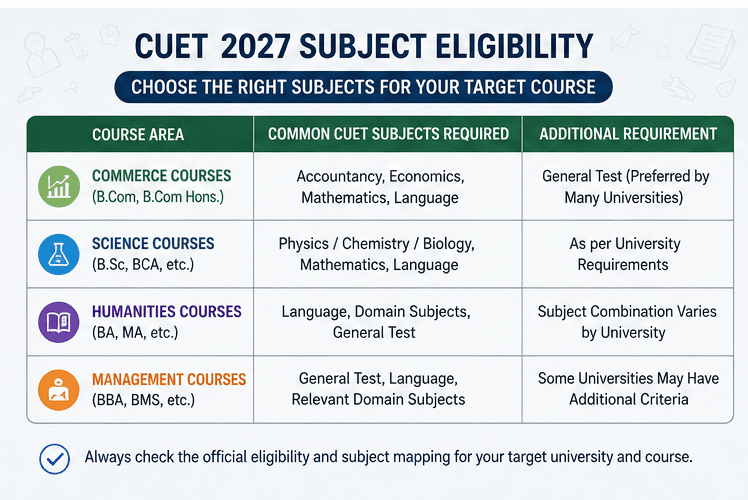
Choosing the correct subjects in CUET UG 2027 is one of the most important steps in the admission process. Participating universities use subject mapping rules to determine whether a candidate is eligible for a particular course. Even a high CUET score may not result in admission if the required subjects were not selected during registration. Therefore, students should finalize their target universities and courses before choosing their CUET subjects.
Different courses require different combinations of language papers, domain subjects and the General Test. For example, some commerce programs may require Accountancy or Mathematics, while science programs typically require subjects such as Physics, Chemistry, Biology or Mathematics. Students aiming for admissions through Delhi University (DU), Banaras Hindu University (BHU), Jamia Millia Islamia (JMI) and other participating universities should carefully verify the official subject requirements before completing the CUET application form.
| Course | Common CUET Subject Requirements |
|---|---|
| B.Com (Hons.) | Language + Accountancy, Mathematics or related domain subjects |
| B.Com | Language + relevant commerce domain subjects |
| B.Sc Physics | Physics, Mathematics and Language |
| B.Sc Chemistry | Chemistry, Physics and Language |
| B.Sc Biology | Biology, Chemistry and Language |
| BA English | Language + relevant domain subjects |
| BA Economics | Mathematics, Language and relevant domain subjects |
| BBA / BMS | General Test, Language and university-specified subjects |
Subject requirements vary by university and course. Candidates should always consult the latest admission guidelines of their preferred universities to ensure they select the correct CUET subjects. Verifying subject eligibility before registration can significantly improve admission opportunities and help avoid common application mistakes.
CUET 2027 Stream-Wise Eligibility Overview
Students from Science, Commerce and Humanities streams can all apply for CUET UG 2027. However, eligibility for individual courses depends on the candidate's Class 12 subjects, CUET subject selection and university-specific admission requirements. The table below provides a quick overview of the most common courses available to students from different streams.
| Class 12 Stream | Popular CUET Courses | Important Eligibility Considerations |
|---|---|---|
| Science (PCM/PCB) | B.Sc, BCA, BBA, BA, B.Com, Multidisciplinary Programs | May require Physics, Chemistry, Mathematics or Biology depending on the course |
| Commerce | B.Com, B.Com (Hons.), BBA, BMS, Economics, BA Programs | Some courses may require Mathematics or Accountancy |
| Humanities / Arts | BA (Hons.), Journalism, Social Sciences, Psychology, BBA | Language and relevant domain subjects are often important |
| NIOS Students | Eligible for most CUET-participating universities | Must satisfy university-specific eligibility requirements |
| Previous-Year Pass-Outs | Eligible for all applicable programs | No restriction on year of passing by NTA |
Students should remember that stream eligibility alone does not guarantee admission. Universities may prescribe specific CUET subject combinations, minimum marks requirements and course-specific conditions. Always verify the latest eligibility criteria before submitting your CUET application.
CUET 2027 Eligibility for Commerce Students
Commerce students are among the largest groups of candidates appearing for CUET UG 2027. Students who have completed or are appearing in Class 12 with Commerce subjects can apply for a wide range of undergraduate programs including B.Com, B.Com (Hons.), BBA, BMS, Economics, Management Studies, Banking, Finance and several multidisciplinary courses offered by participating universities. Eligibility requirements may vary depending on the university and course selected.
While Commerce students are generally eligible for most commerce-related programs, some universities require specific subject combinations in both Class 12 and CUET. For example, certain B.Com (Hons.) and Economics programs may require Mathematics as a mandatory subject, while others may accept Accountancy, Business Studies or related commerce subjects. Students should carefully verify the subject mapping requirements of universities such as Delhi University (DU), Banaras Hindu University (BHU), Jamia Millia Islamia (JMI) and other participating institutions before choosing their CUET subjects.
| Popular Course | Typical Eligibility for Commerce Students |
|---|---|
| B.Com | Commerce background with relevant CUET subjects |
| B.Com (Hons.) | May require Mathematics, Accountancy or specific domain subjects |
| BBA | Language, General Test and university-specified subjects |
| BMS | General Test and required CUET subject combination |
| BA Economics | Often requires Mathematics |
| Finance and Banking Programs | Commerce background preferred |
Commerce students should not assume that all universities follow identical eligibility rules. Before applying, candidates should review the latest admission guidelines of their preferred universities to ensure they meet the required subject combinations, minimum marks criteria and course-specific eligibility conditions.
CUET 2027 Eligibility for Science Students
Science students have some of the widest admission opportunities through CUET UG 2027. Candidates from both PCM (Physics, Chemistry, Mathematics) and PCB (Physics, Chemistry, Biology) backgrounds can apply for a variety of undergraduate programs offered by participating universities. In addition to traditional science courses such as B.Sc Physics, B.Sc Chemistry, B.Sc Mathematics and B.Sc Biology, science students may also be eligible for several commerce, management and humanities programs depending on university-specific admission requirements.
Most science-related courses require students to appear in relevant CUET domain subjects. For example, engineering-oriented programs may require Physics and Mathematics, while life science programs may require Biology and Chemistry. Some universities also allow science students to apply for B.Com, BBA, Economics and multidisciplinary programs, provided they satisfy the required subject combinations. Students should carefully review the eligibility and subject mapping guidelines of universities such as Delhi University (DU), Banaras Hindu University (BHU), Jamia Millia Islamia (JMI) and other participating institutions before finalizing their CUET subject selection.
| Popular Course | Typical Eligibility for Science Students |
|---|---|
| B.Sc Physics | Physics, Mathematics and Language |
| B.Sc Chemistry | Chemistry, Physics and Language |
| B.Sc Mathematics | Mathematics and related domain subjects |
| B.Sc Biology | Biology, Chemistry and Language |
| BCA | May require Mathematics depending on university |
| BBA | General Test, Language and university-specified subjects |
| B.Com | Possible at many universities subject to eligibility requirements |
| BA Programs | Generally eligible subject to university rules |
Science students should not assume that eligibility automatically guarantees admission. Universities may prescribe specific domain subjects, minimum marks requirements and course-specific conditions. Checking eligibility before CUET registration can help candidates choose the correct subjects and maximize their admission opportunities.
CUET 2027 Eligibility for Humanities Students
Humanities and Arts students can access a wide range of undergraduate courses through CUET UG 2027. Candidates who have completed or are appearing in Class 12 with subjects such as History, Political Science, Geography, Sociology, Psychology, Economics, English or other humanities disciplines are eligible to apply for numerous programs offered by participating universities. Popular options include BA (Hons.), Journalism, Mass Communication, Social Sciences, Political Science, Psychology, Public Administration and several multidisciplinary courses.
In addition to traditional Arts programs, many universities also allow humanities students to apply for management and commerce-related courses such as BBA, BMS and selected interdisciplinary programs, provided they meet the required subject combinations and eligibility conditions. Students should carefully verify university-specific requirements because certain courses may require particular CUET domain subjects, language papers or the General Test.
| Popular Course | Typical Eligibility for Humanities Students |
|---|---|
| BA (Hons.) English | Language and relevant domain subjects |
| BA (Hons.) Political Science | Language and relevant humanities subjects |
| BA (Hons.) History | Language and relevant humanities subjects |
| Journalism and Mass Communication | Language, General Test and university-specific requirements |
| Psychology Programs | Subject requirements vary by university |
| BBA | General Test, Language and university-specified subjects |
| BMS | General Test and required subject combination |
| Multidisciplinary Programs | Eligibility varies by university |
Students seeking admission through Delhi University (DU), Banaras Hindu University (BHU), Jamia Millia Islamia (JMI) and other participating universities should review the latest admission brochures before registration. Selecting the correct CUET subjects is essential because eligibility for many humanities courses depends on specific language papers and domain subject combinations.
Can NIOS Students Apply for CUET 2027?
Yes, students who have completed or are appearing for their Class 12 examination through the National Institute of Open Schooling (NIOS) are generally eligible to apply for CUET UG 2027. The National Testing Agency (NTA) recognizes candidates from NIOS and other recognized educational boards for the purpose of appearing in the examination. As a result, NIOS students can compete for admissions to various undergraduate programs offered through participating universities.
However, appearing for CUET and securing admission are two separate processes. While NIOS students are eligible to take the examination, universities may have additional admission requirements related to subject combinations, minimum marks, stream eligibility or course-specific qualifications. Therefore, candidates should carefully review the eligibility criteria of their preferred universities before applying.
| NIOS Eligibility Factor | CUET 2027 Rule |
|---|---|
| NIOS Students | Eligible to apply for CUET UG 2027 |
| Class 12 Appearing NIOS Students | Eligible to apply |
| Previous-Year NIOS Pass-Outs | Eligible to apply |
| Recognition by NTA | Accepted as a recognized educational qualification |
| University Admission Eligibility | Subject to university and course-specific requirements |
Students seeking admission to universities such as Delhi University (DU), Banaras Hindu University (BHU), Jamia Millia Islamia (JMI) and other CUET-participating institutions should verify the latest admission guidelines because eligibility conditions may vary by course. Choosing the correct CUET subjects and meeting university-specific requirements remain important for successful admission.
Can Previous-Year Students Apply for CUET 2027?
Yes, candidates who completed Class 12 in previous years are eligible to apply for CUET UG 2027. The National Testing Agency (NTA) does not impose any restriction based on the year of passing, allowing previous-year pass-outs to appear for the examination and compete for admissions to participating universities. Whether a student passed Class 12 in 2026, 2025 or earlier, they can generally apply for CUET provided they satisfy the admission requirements of their chosen universities and courses.
This flexibility benefits students who took a gap year for competitive exam preparation, career exploration, skill development, personal reasons or other educational pursuits. However, while previous-year students are eligible to appear for CUET, universities may prescribe additional conditions related to minimum marks, subject combinations, stream requirements or course-specific qualifications. Candidates should therefore verify the latest admission guidelines before submitting their applications.
| Previous-Year Candidate Eligibility Factor | CUET 2027 Rule |
|---|---|
| Passed Class 12 in 2026 | Eligible |
| Passed Class 12 in 2025 | Eligible |
| Passed Class 12 Before 2025 | Generally eligible |
| Gap-Year Candidates | Eligible |
| Restriction on Year of Passing | No restriction by NTA |
| Final Admission Eligibility | Subject to university-specific requirements |
Students planning to seek admission through Delhi University (DU), Banaras Hindu University (BHU), Jamia Millia Islamia (JMI) and other CUET-participating universities should check course-specific eligibility criteria because admission requirements may differ across institutions and programs.
University-Wise Eligibility Through CUET 2027
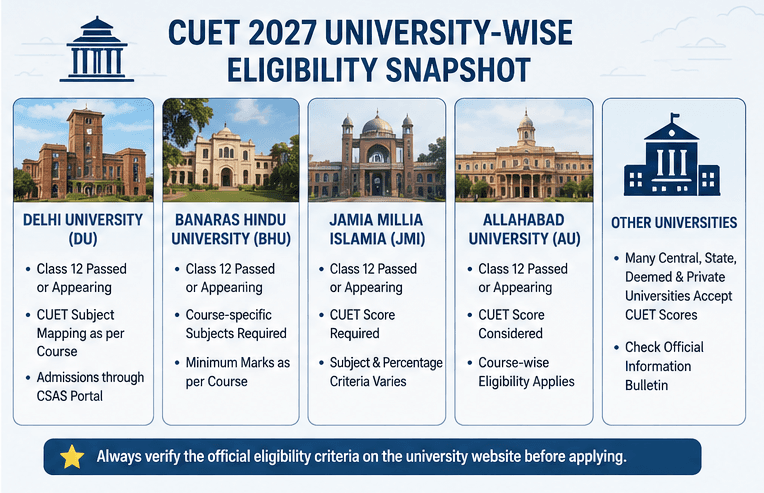
Although CUET UG 2027 provides a common entrance platform for admissions, each participating university follows its own eligibility criteria, subject mapping rules and course-specific admission requirements. Students should carefully review the admission guidelines of their preferred universities before selecting CUET subjects and submitting applications.
Delhi University (DU) Eligibility Through CUET 2027
Delhi University admits students to undergraduate programs through CUET scores. Candidates must appear in the appropriate language and domain subjects required for their chosen course. Subject mapping is extremely important because eligibility for programs such as B.Com (Hons.), BA (Hons.), Economics and Science courses depends on the specific CUET subjects selected. Students should verify course-wise eligibility requirements through the official DU admission guidelines.
Banaras Hindu University (BHU) Eligibility Through CUET 2027
Banaras Hindu University uses CUET scores for admission to numerous undergraduate programs across arts, commerce and science streams. Candidates must satisfy the educational qualification requirements and subject combinations prescribed for their chosen course. Eligibility requirements may vary across departments and programs.
Jamia Millia Islamia (JMI) Eligibility Through CUET 2027
Jamia Millia Islamia accepts CUET scores for several undergraduate courses. Students should carefully review course-specific eligibility criteria because subject requirements, minimum marks conditions and admission procedures may differ depending on the program selected.
Allahabad University Eligibility Through CUET 2027
Allahabad University considers CUET scores for admissions to various undergraduate programs. Candidates must satisfy both the university's educational qualification requirements and the course-specific eligibility conditions applicable to their chosen program.
Other Universities Accepting CUET 2027 Scores
Apart from DU, BHU, JMI and Allahabad University, several central, state, deemed and private universities use CUET scores for undergraduate admissions. Eligibility requirements vary across institutions, making it important for students to review the latest admission brochures before applying.
| University | Key Eligibility Requirement |
|---|---|
| Delhi University (DU) | Course-wise subject mapping and CUET score requirements |
| Banaras Hindu University (BHU) | Required Class 12 subjects and CUET eligibility conditions |
| Jamia Millia Islamia (JMI) | Course-specific eligibility and admission requirements |
| Allahabad University | Class 12 qualification and CUET score requirements |
| Other Participating Universities | Eligibility varies by institution and course |
Since university eligibility rules change periodically, candidates should always verify the latest admission information published by their preferred universities. Checking eligibility before registration helps ensure the correct selection of CUET subjects and improves admission opportunities.
Common Eligibility Mistakes Students Make
Every year, thousands of students lose admission opportunities despite securing good CUET scores because they overlook important eligibility requirements. Understanding the most common eligibility mistakes can help candidates avoid unnecessary complications during counseling and admission.
- Selecting incorrect CUET subjects that do not match course requirements
- Ignoring university-specific eligibility criteria
- Failing to verify minimum marks requirements for the chosen course
- Missing mandatory subject combinations required by universities
- Assuming all universities follow the same admission rules
- Choosing CUET subjects before finalizing target courses and universities
- Not checking language paper requirements for specific programs
- Overlooking eligibility conditions for reserved categories
- Relying on outdated admission information from previous years
- Submitting applications without reviewing official university guidelines
| Common Mistake | Potential Consequence |
|---|---|
| Incorrect CUET Subject Selection | May become ineligible for the desired course |
| Ignoring Subject Mapping Rules | High score may not lead to admission |
| Not Checking Minimum Marks Criteria | Application may be rejected during admission |
| Using Outdated Eligibility Information | Missing revised university requirements |
| Ignoring Course-Specific Conditions | Ineligibility despite meeting basic CUET criteria |
The best way to avoid these mistakes is to shortlist your preferred universities and courses before filling out the CUET application form. Carefully reviewing university admission brochures, subject mapping requirements and eligibility criteria can significantly improve your chances of securing admission to your desired program.
How to Check Your CUET 2027 Eligibility
Before registering for CUET UG 2027, students should verify both the general CUET eligibility criteria and the specific admission requirements of their target universities. Following a systematic eligibility check can help avoid application mistakes, incorrect subject selection and admission-related issues later in the counseling process.
- Shortlist your preferred universities and courses
- Confirm that you have passed or are appearing in Class 12 from a recognized board
- Review the official eligibility criteria of each university
- Check course-specific subject requirements and subject mapping rules
- Verify the CUET subjects required for your chosen course
- Review minimum marks requirements, if applicable
- Confirm category, reservation and quota eligibility
- Check whether the General Test or language papers are required
- Review the latest university admission brochure
- Complete CUET registration using the correct subject combinations
| Eligibility Checkpoint | What to Verify |
|---|---|
| Educational Qualification | Class 12 pass or appearing status |
| University Eligibility | Course-specific admission requirements |
| Subject Selection | Required CUET domain subjects and language papers |
| Minimum Marks | University-specific percentage requirements |
| Category Eligibility | Reservation and quota benefits |
| Final Application Review | Correct subjects and course preferences |
Students who complete this eligibility checklist before registration are less likely to face admission problems later. Since eligibility requirements can vary across universities and courses, candidates should always rely on the latest official admission guidelines rather than assumptions or outdated information.
How Padae Partner Helps
Padae Partner helps students shortlist courses, select the right CUET subjects, understand university-specific eligibility and avoid common application mistakes. Our counseling team supports students from registration to final admission.
Important CUET 2027 Eligibility Rules at a Glance
The table below summarizes the most important CUET UG 2027 eligibility rules that every candidate should know before applying. While these are the general eligibility guidelines prescribed for CUET, students should also review the admission requirements of their preferred universities because course-specific conditions may vary.
| Eligibility Factor | CUET 2027 Rule |
|---|---|
| Educational Qualification | Passed or appearing in Class 12 or equivalent examination |
| Recognized Boards | CBSE, ICSE, State Boards, NIOS and equivalent boards |
| Age Limit | No upper age limit prescribed by NTA |
| Minimum Marks | No minimum percentage required by NTA; university rules may apply |
| Class 12 Appearing Students | Eligible |
| Previous-Year Pass-Outs | Eligible |
| Gap-Year Students | Eligible |
| NIOS Students | Eligible subject to university requirements |
| Subject Selection | Must satisfy course and university subject requirements |
| Foreign Nationals | Eligible as per university admission policies |
| Attempt Limit | No restriction on attempts |
| Final Admission Eligibility | Determined by the participating university |
Students who meet the basic CUET eligibility criteria should still verify course-specific requirements, subject combinations, minimum marks conditions and admission rules before completing the registration process. Checking eligibility in advance can help avoid common admission mistakes and improve the chances of securing admission to the desired university and course.
Frequently Asked Questions
Can a student with a gap year apply for CUET 2027?
Yes, gap-year students are eligible.
Can a 30-year-old apply for CUET?
Yes, there is no upper age limit prescribed by NTA.
Can commerce students apply for science courses through CUET?
Eligibility depends on university requirements and subject combinations.
Do I need Mathematics for CUET?
Mathematics is required only for specific courses and universities.
Can foreign students apply through CUET?
Many participating universities permit foreign candidates subject to their admission policies.
Can I use one CUET score for multiple universities?
Yes, CUET scores can be used for admissions across participating universities.
Is NIOS valid for Delhi University through CUET?
Yes, recognized NIOS qualifications are generally accepted.
Need Help Understanding CUET Eligibility?
Get clear guidance from Padae Partner before you choose your next step.